The British Colossus
was the first ever operational programmable
digital electronic computer. This top-secret
computer came into service at the end of 1943 and
was developed to break German telex traffic,
encrypted with the Lorenz SZ40/42 machines.
Although Colossus operated two years earlier than
the publicly well-known American ENIAC, it never
received the proper credit due to its top secret
status during and after the war. Only in the late
1970's, information about the Colossus became
available. Unfortunately, the machine is hardly
mentioned in history books.Breaking Tunny
During the Second World War,
codebreakers of the Government Code and Cipher
School (GC&CS) in Bletchley Park, England,
were tasked to break German telex messages that
were encrypted with the Lorenz SZ40/42 machine.
This machine secured the top secret high-level
communications of the German armed forces.
British codebreakers gave the codename
"Fish" to all encrypted German telex
traffic, and the Lorenz machine and its traffic
was codenamed "Tunny".
The Lorenz was an on-line
cipher machine and used 12 irregular moving
pinwheels to create a pseudo-random 5-bit stream
which was mixed with the plain 5-bit telex
signal. When codebreakers at Bletchley discovered
statistical biases in the random bits, generated
by the Lorenz machine, they developed
cryptanalytic attacks to break the Lorenz
messages.
Building the Colossus
The codebreakers soon realized
that they needed a machine to process the large
number of Tunny messages. Early 1943 the
mathematician Max Newman designed the "Heath
Robinson", an electro-mechanical machine to
break the Lorenz traffic. The prototype became
operational in June 1943 but had several
technical issues.
Meanwhile, a team led by the
brilliant engineer Tommy Flowers, assisted by Max
Newman, worked on a top secret project in the
Post Office Research Station in Dollis Hill near
London. The goal was to develop and build an
advanced digital and programmable version of the
Heath Robinson. The machine, named Colossus Mark
I, was ready by the end of 1943. All parts were
moved to Bletchley Park and assembled during the
Christmas holidays by Don Horwood and Harry
Fensom.
By mid-January 1944, Colossus
was finished and began its task to break the top
secret German communications. Colossus Mark II,
an improved version, entered service in June
1944. The Mark II was 5 times faster and easier
to program than the Mark I. The existing Colossus
Mark I was revised, more Mark II's were built,
and a total of 10 Colossus computers were
operational by the end of the war.
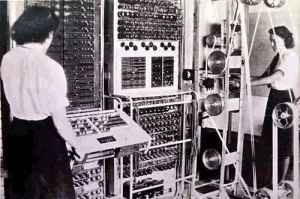
Colossus at Work
The Colossus was the first ever
to use shift registers and counters, and could
perform Boolean calculations. It was programmable
by switches and plug panels. The Mark I had two
racks with 1,500 vacuum tubes and the Mark II
2,500 tubes. They were used to store the virtual
Lorenz settings and to do the statistical
calculations. Colossus could perform parallel
calculations, enabling very high speed. The 5-bit
paper tape, containing the message ciphertext,
was read by a tape reading system and the
Colossus was electronically synchronized with the
tape.
The tape speed was the limiting
factor of the Colossus. Therefore, they designed
a unique high-speed tape reader that could
operate at speeds up to 9,700 characters per
second. For safer use it was limited to 5,000
characters, which was still an incredible speed
for a small paper ribbon! I had the opportunity
to check out the running Colossus, and its speed
was truly impressive!
The Colossus computers were
very successful and broke an enormous number of
top secret German messages. The information,
obtained from the broken Tunny messages, was
codenamed ULTRA. This classification was used for
all critical and very sensitive information,
obtained by cryptanalysis of enemy messages.
Another source of ULTRA was the
breaking of the German Enigma cipher machine. Its cryptanalysis was supported by
another machine called the Bomba, developed by
Polish cryptologist Marian Rejewski to retrieve
the settings of the Enigma. Alan Turing and
Gordon Welchman later improved that machine under
the name Bombe. ULTRA played a decisive role in
the outcome of the war.
After the War
Bletchley Park closed after the
war and eight Colossus computers were destroyed
for security reasons. The two remaining computers
were moved together with the GC&CS to
Cheltenham. They were dismantled in 1960. After
the war, the Colossus computers and their success
remained top secret for decades. No one knew
about the Colossus, and for many years, the
American ENIAC received the undeserved credit of
being the first programmable digital computer.
Ironically, it was the National
Security Agency who, by releasing old archives
under the Freedom of Information Act at the end
of the 1970's, showed that Colossus had beaten
them by two years. It is now recognized that the
Colossus, and the people who designed it, had a
significant influence on the development of early
computers.
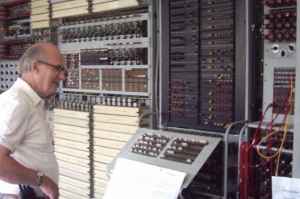
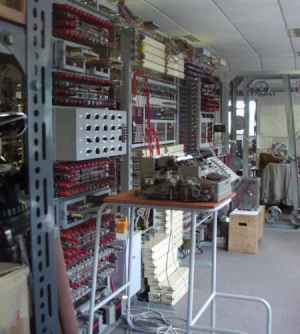
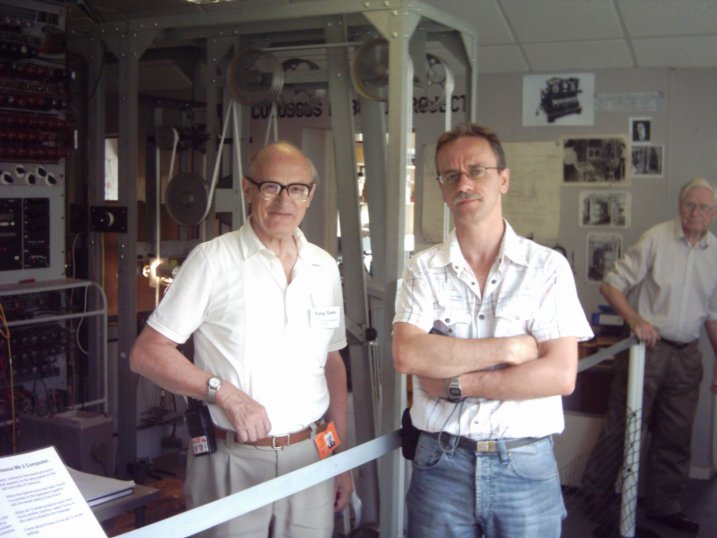
Computer expert Tony Sale and
his team, which included some of the original
engineers, have reconstructed the Colossus
computer. The input of the original designers was
invaluable since most of the secret plans of
Colossus were destroyed. The operational and
running Colossus is located in Bletchley Park and
I can highly recommend a visit.