These
pages provide news, articles, and links about
historical ciphers and codes, cipher machines,
and cryptography-related exhibits and events,
from ancient history through the First and Second
World Wars to the Cold War and beyond.
If you
have interesting news on cryptologic
history, then contact
us. History
is here to share!
BURG
FEUERSTEIN LABORATORIUM 11 February
2016
There are many stories, some
more fiction than real, about mysterious Nazi
laboratories in dark castle dungeons where SS
scientists performed all kinds of occult
experiments. The Nazi obsession with the
Ahnenerbe, the elite Wewelsburg SS school and
center for archaeological excavations are
probably the most sinister real examples,
portrayed in pc games like Return to Castle
Wolfenstein.
What if someone told you that a
team of scientists, led by Doctor Oskar Vierling,
worked in a secretive laboratorium called Castle
Feuerstein. Sounds like another sequel to the
Castle Wolfenstein game? Not at all. Burg
Feuerstein in Ebermannstadt, close to Nürnberg,
was anything but fiction. A physicist in a
mysterious laboratorium? How could that relate to
cryptography and intelligence?
The Hunt for Science
Burg Feuerstein was an
important target of the Target Intelligence
Committee (TICOM), a secret WW2 British-American
project to capture German scientists and seize
SIGINT stations, cryptographic and communications
equipment, just before Germany surrendered. The
mission of TICOM was to collect as much as
possible German science and technology,
preferably before Soviet forces got their hands
on it. To achieve this, TICOM sent fast-moving
teams to pre-determined valuable locations inside
the collapsing Germany, sometimes ahead of Allied
troops.
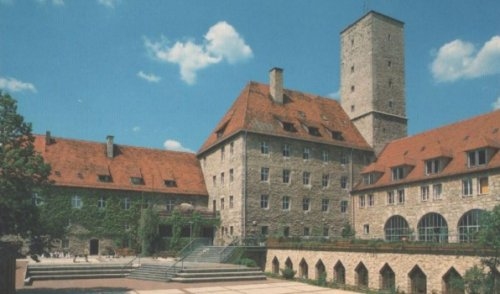
Burg Feuerstein in Ebermannstadt
Is there a better way to hide a
secret laboratorium than to build a typical
Frankischen Schweiz style castle on top of a
mountain in plain sight? It was so obtrusive that
no one would suspect its purpose. Burg Feuerstein
was built from scratch in 1941 by Dr Vierling
with private funds. He was a physicist,
electronics engineer and professor in
high-frequency technology and electroacoustics.
Laboratorium Feuerstein started its research in
1942 and developed experimental communications
systems. At its peak, Feuerstein housed 200 staff
and workers. TICOM only learned about
Feuerstein's existence from decoded intercepts
that referred to its research.
A Most Prolific
Scientist
The scientists, led by Dr
Vierling, worked on a variety of projects,
including high speed transmitters for covert
agents, receivers, wave traps, accurate filter
design, speech scramblers, voice frequency
spectrography, teleprinter cipher (crypto)
attachments, improvements on cipher machines, a
synchronisation system for the Lorenz SZ42 cipher
teleprinter, acoustics and filter components for
acoustic torpedoes, anti-radar coating for
submarines, a night fighter control system,
various frequency generators and an electronic
calculator to solve sine and cosine equations.
They were a busy bunch!
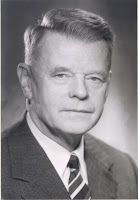
Oskar Vierling
Just before the German
collapse, Dr Vierling was ordered to relocate his
speech projects to Berchtesgaden in the Bavarian
Alps and to destroy all other projects and
equipment. Vierling, however, had other plans
with his Feuerstein legacy. Once the Nazi's were
off to Berchtesgaden with the speech equipment,
he stored the most valuable equipment and plans
in a large bomb proof walk-in vault, hidden
behind a false wall in Feuerstein. There, he
awaited the end of the war.
Vierling Safeguards His
Future
Burg Feuerstein was used as a
German Army hospital at the time the TICOM team
arrived. They rounded up the scientists and Dr
Vierling proved very willing to cooperate with
TICOM. Vierling and his group rushed to restore
the laboratory and continued their work on
selected projects under control of TICOM
investigators.
NSA's declassified AXIS SIGINT
in WWII, Vol II, Notes on
German High Level Cryptography and Cryptanalysis contains
some interesting crypto related info. The Lorenz
SZ-42c cipher teleprinter with synchronisation,
named SK-44 and SK-45, generated and send a
continuous pseudo-random five-bit stream. The
receiver mixed his identical stream, by XOR-ing,
with the incoming stream, resulting in no
character, since (K ⊕ K) = 0. When sending a message, the
plain teleprinter message was mixed into the
stream. The receiver mixed the received signal
with his identical stream, cancelling out the
pseudo-random stream, since (K ⊕ M) ⊕ K = M, producing the
original message instantly.
An eavesdropper would not know
if or when the random stream contained an actual
message or how long it was, thus effectively
preventing traffic analysis. The U.S. Army
Security Agency (ASA) suggested that analysis of
the continuous mostly non-message-carrying
pseudo-random stream, generated by the SZ-42c,
might compromise the machine's secret key
settings. This would enable them to predict the
stream and decipher all messages that follow. The
principle of continuous random stream was
nevertheless brilliant and used on the 1950s more
advanced U.S. KWR-37 JASON and KWT-37 Fleet
Broadcast crypto system.
Speech scrambling research by
Dr Vierling's team produced little result. In
1943, only Dr Vierling and Telefunken still
worked on ciphony (encrypted voice) and from 1944
on only Dr Vierling. At war ends, Feuerstein's
research on ciphony focused on synthetic speech,
encrypted by triple wobbling. The speech was
separated in eight frequency bands. These were
encrypted in a three-stage ring wobbling
(shifting the frequencies up and down) where the
stage was split in half and these halves wobbled
separately. However, speech quality after
de-wobbling was very bad and ASA considered the
German scientists several years away from
developing any usable ciphony.
Declassified Feuerstein
Documents
More details about the
Feuerstein laboratory and Dr Vierling's work is
available in chapter VIII, page 37 (pdf p.39)
from Volume 8
Miscellaneous NSA of NSA's declassified files on European Axis
Signal Intelligence in World War II. The
rebuild of the lab under control of TICOM is
described the Interim Report on
Laboratorium Feuerstein from the
NARA archive. (first pages are double, start
reading from page 5). Another excellent source is
the TICOM Archive (preserved
by the Internet Archive). These documents contain
enough inspiration for a few Wolfenstein sequels.
The importance of Burg
Feuerstein for TICOM is shown in the ASA
documents. The Temporary Duty
Report NSA of Mr William Friedman, the renowned
U.S. cryptologist, is a resume of his tour in
Germany from July to September 1945, in
cooperation with TICOM. Vierling's Laboratorium,
noted as important TICOM target, was one of the
sites he visited in July 1945. NSA has a few more
documents related
to Dr Vierling.
Post-War Crypto and
Intelligence Work
After the war, Prof Dr Vierling
continued working at his 1941 established firm VIERLING GmbH, but
relocated to Ebermannstadt, a mere kilometer from
Burg Feuerstein. He had quite a prolific career,
developing crypto machines, covert radio
transmitters, eavesdropping devices, radio
direction finding and various measuring and test
equipment. He also worked for Organisation Gehlen
(post-war West-German intelligence), and its
successor, the Bundesnachrichtendienst (foreign
intelligence), the Zentralstelle für
Chiffrierwesen (central cryptologic service) and
the Deutsche Bundespost. From the 1930s until the
1950s he was also an important pioneer in the
development of electronic and electro-acoustic
instruments.
Due to legal restrictions on
crypto export, Dr Vierling sold the rights for
his crypto equipment to Crypto AG's predecessor Hagelin
Cryptos. NSA archives
show that Dr Vierling developed crypto machines
in cooperation with ASA and NSA, at least until
1953. See also documents Crypto devices of
Vierling, ASA loan Vierling
device
and purchase
transistors for Vierling. These
documents show that Vierling provided a crypto
machine for analysis, and ASA supplied
transistors for Vierling's crypto experiments.
Transistors were quite novel in 1953 and their
use in crypto equipment pretty unique. Vierling's
firm is still located in Ebermannstadt. Today,
Burg Feuerstein is a catholic youth
center.
The Bayerischer Rundfunk has an audio on the
wartime history of Burg Feuerstein (in
German).
BAPCO's USE OF ONE TIME PADS
DURING WORLD WAR II10 February 2015
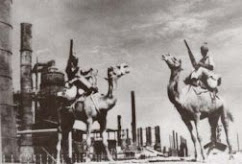
Mounted camel guard at
refinery
Source: BAPCO
The Bahrain Petroleum
Company (BAPCO) was a Canadian subsidiary,
founded in 1929 by the American Standard Oil of
California (Socal) to run its operations at the
Awali oil fields on Bahrain Island, at the inlet
of the Persian Gulf.
BAPCO became a possible target
of Axis forces when Britain declared war on
Germany. In 1940, the Bahrain oil refinery was targeted by
Italian bombers, forcing the Allies to strengthen
Bahrain's defense. Bahrain, in 1943 still a
British Protectorate, decided to implement a
censorship on messages sent over commercial cable
and wireless, to prevent disclosure of
information that might be useful to the enemy.
This censorship, however,
greatly restricted the communications and
operations of BAPCO. The majority of their
messages contained information about oil
production, shipping, personnel, and food supply.
Those messages fell into three main categories:
a) cables that could be sent in plain text
without objection, b) security cables that
contained information that, in conjunction with
other information, might indirectly be useful to
the enemy, and c) secret cables that would be of
direct use to the enemy if intercepted, such as
ship movements, especially oil tankers.
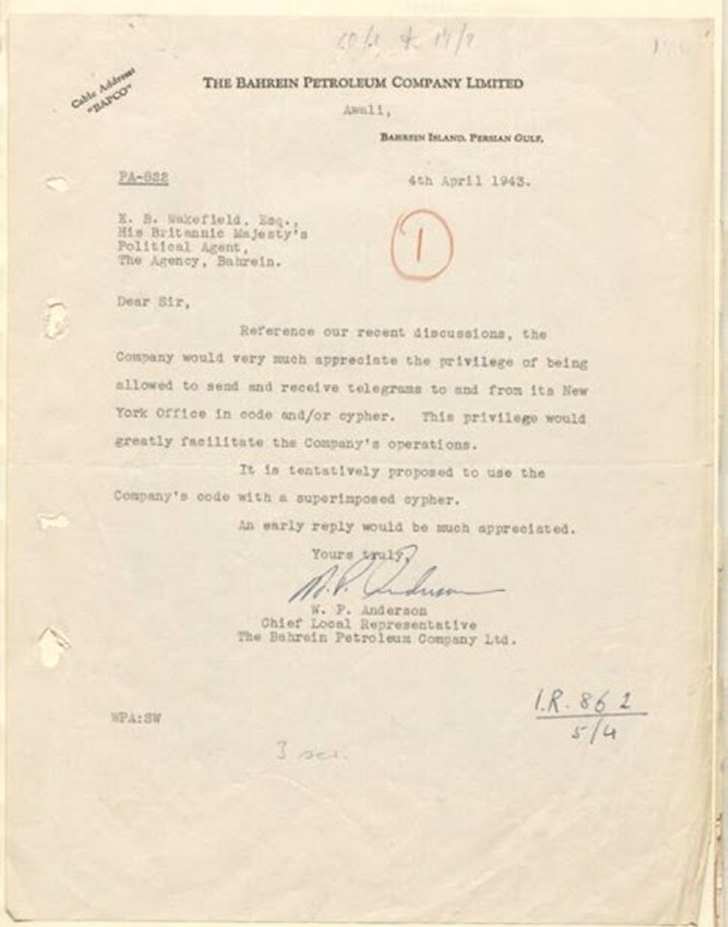
On April 4, 1943, Ward P.
Anderson, the general manager and chief local
representative of BAPCO, asked E. B. Wakefield,
the British Political Agent in Bahrain,
permission to encrypt their cables between the
local branch and their New York office. This
would allow them to send security related cables,
at the same time respecting Bahrain's censorship.
Anderson proposed a secret company code,
superimposed (enciphered a second time) with a
transposition cipher for added security.
BAPCO's Ward Anderson's request to use code or
cypher to encrypt telegrams
The Political Resident of the
Persian Gulf in Camp Bahrain forwarded the
request on April 8 to the Secretary of State for
India in London, who approved the use of a secret
code, provided that censorship received a plain
text version of all messages, sent in that code.
BAPCO should continue to send messages through
the Navy if they contained vital information that
would be of direct use to the enemy. Messages
regarding political matters were to be sent
through the Political Agent. After consulting the
New York office, Ward Anderson agreed to these
conditions.
P.A.I.C. in Baghdad asked
whether the code had already been vetted for
security. As this was not the case, the British
Political Resident forwarded the request to SNOPG
(Senior Naval Officer in the Persian Gulf) in
Basra but they had no officer qualified to vet
the code. Therefore, PAIFORCE suggested to vet
the code.
The new code, proposed by the
California Texas Oil Company, arrived from New
York on October 24, and Bahrain forwarded the
code on November 10 by courier for examination to
the Cipher Security Officer of P.A.I.C. in
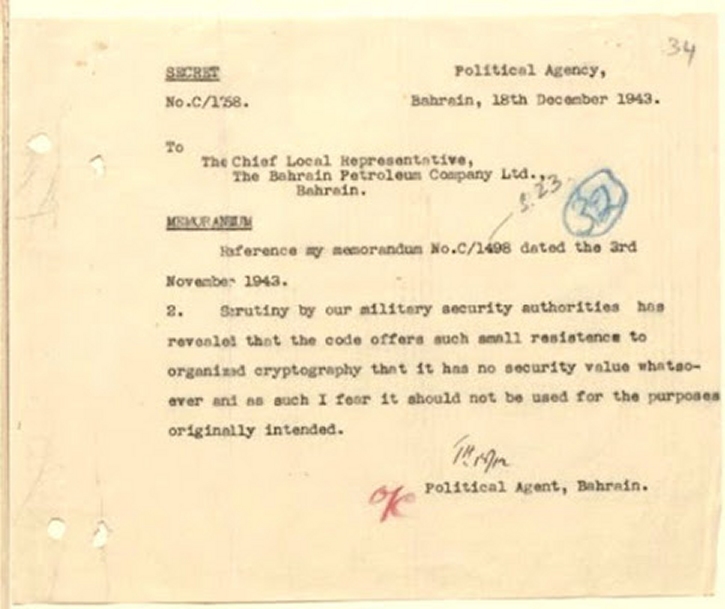
Baghdad. After reviewing the code, the Security
Officer responded that the code offered little
resistance against cryptanalysis and provided no
security whatsoever. Note: P.A.I.C. (Persia and
Iraq Command) in Baghdad was the headquarters of
PAIFORCE (Persia and Iraq Force), the British and
Commonwealth military formation in the Middle
East from 1942 to 1943.
The Political Agency's responds that the
requested code offers no security
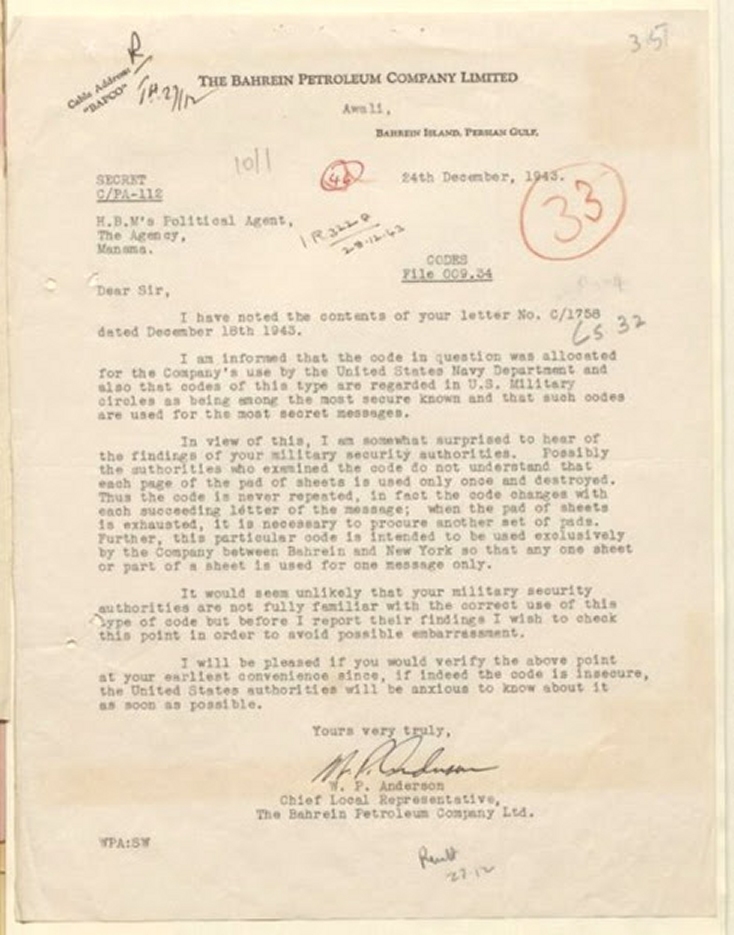
Surprised by this answer, Ward
Anderson explained that the code was allocated by
the U.S. Navy Department and considered the most
secure known, used for the most secret messages.
He clarified that "each page of the pad of
sheets is used only once and destroyed after
use". He continues, "In fact, the code
changes with each succeeding letter of the
message. When the pad is exhausted, a new set of
pads is produced".
To Anderson, it seemed unlikely
that British military authorities would be
unfamiliar with the proper use of this type of
code, so he asked to verify whether the code was
indeed insecure, adding that U.S. authorities
would be most interested if the British claims
proved correct.
This was his polite way to hint
the Political Agency and the PAIFORCE Security
Officer that they were going to embarrass
themselves. To their defense, it might be
possible that the code was not accompanied with
the complete and proper coding instructions, thus
failing to show that the code was for one-time
use.
Ward Anderson explains that the code is one-time
pad
Soon after, the Secretary of
State for India in London informed the Political
Resident in Bushire, Iran, that the U.S. Chief of
Cable Censorship urgently requested permission to
use the code, adding that it was a one-time pad,
similar to the one used by the Ministry of War
Transport in London. P.A.I.C. also received note
of this. Apparently, someone pulled some strings.
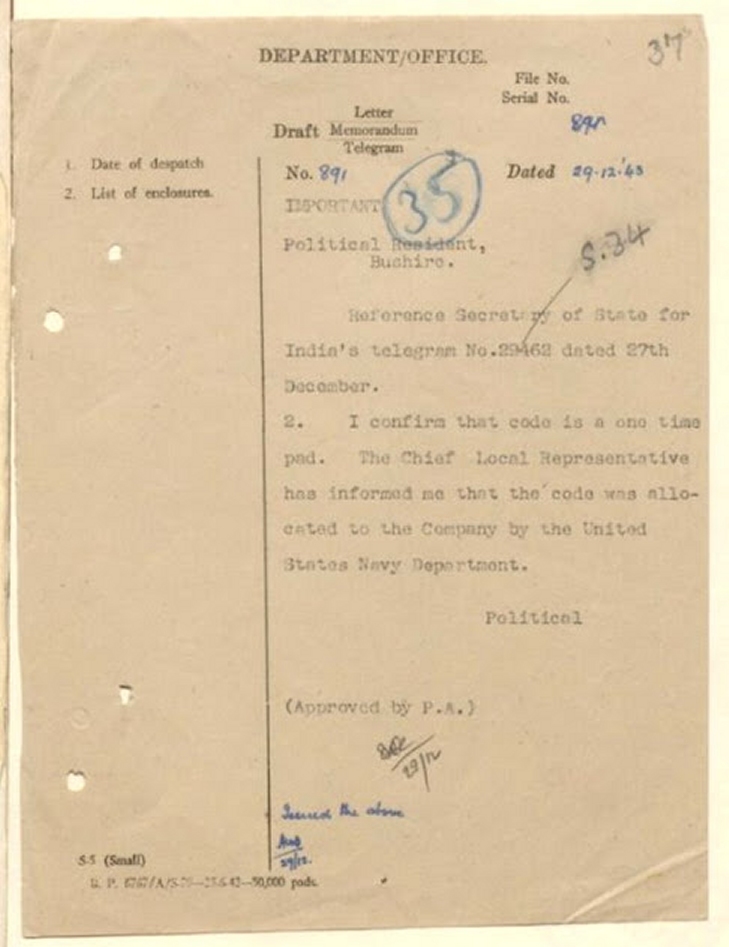
Subsequently, the Political
Resident confirmed to its agency in Bahrain that
the code was indeed a one-time pad from the U.S.
Navy Department. Eventually, the agent informed
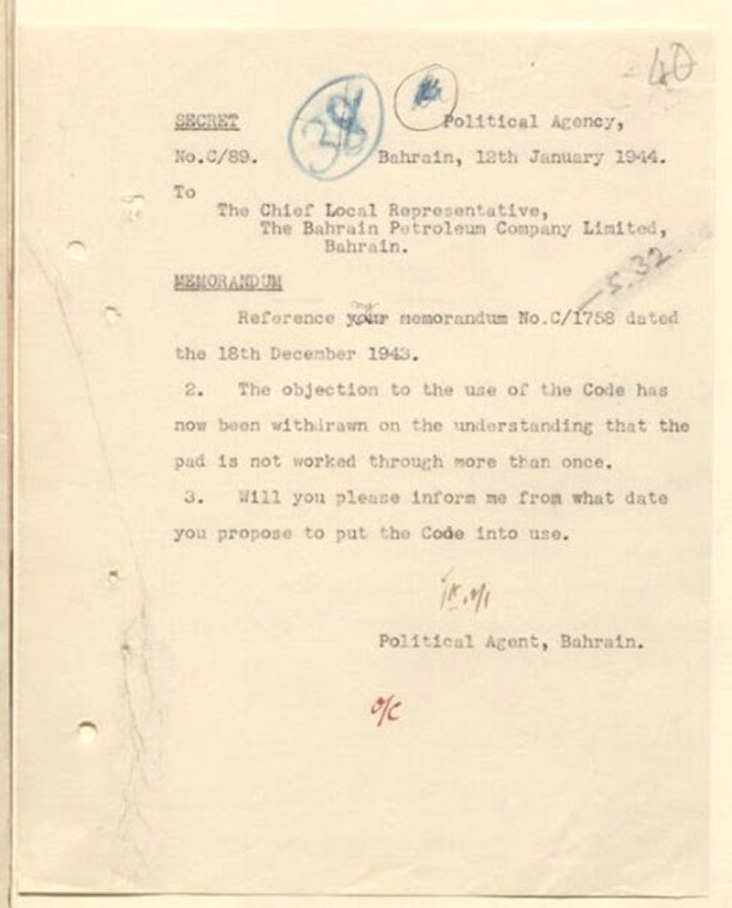
the BAPCO representative that objection to the
code had been withdrawn and that "the
one-time pad can be used on the understanding
that the pad is not worked through more than
once".
Political Resident confirms the code is a
one-time pad
Political Agency Bahrain confirms objection using
code is withdrawn
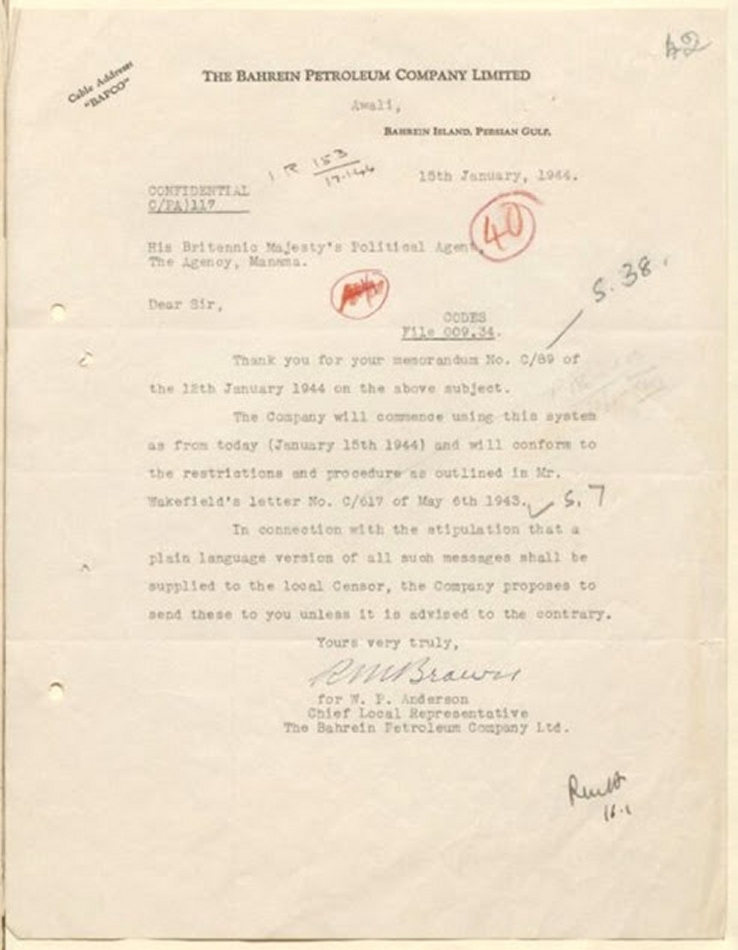
BAPCO starts using the one-time pad encryption
immediately
BAPCO started using the
one-time pads as of January 15, 1944, more than
eight months after their initial request. Yes,
even during wartime, bureaucrats persist. Of
course, we have to take in account that
transportation and communication means in 1943
were quite different from today, and codes were
always transferred safe-hand by courier.
Once the war had ended, BAPCO
requested on August 22, 1945 permission from
Bahrain to commence the use of the company's own
cable code again, as used before the outbreak of
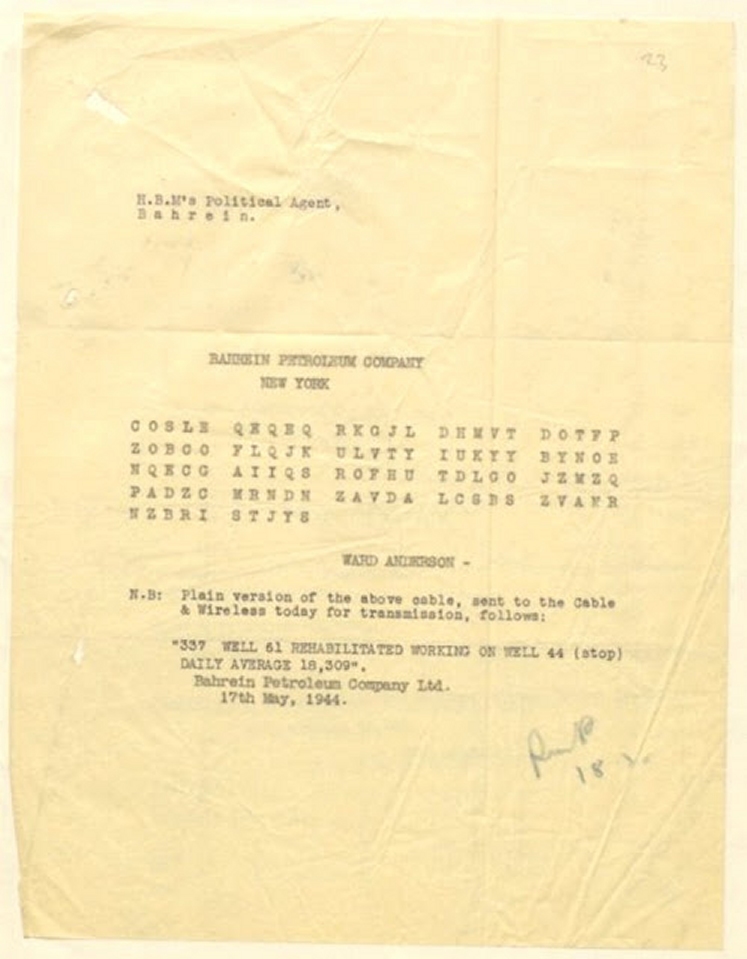
hostilities in 1939. Below one of the BAPCO coded
messages from Bahrain to New York, with plain
version included, submitted to Censorship as
agreed with British authorities.
BAPCO encrypted messages to New York with plain
version included to Censorship.
These archived conversations
are a rare example of a commercial firm using the
unbreakable one-time pad in the early 1940s. At
that time, the use of such strong encryption was
generally limited to governments, their military,
intelligence agencies, and diplomacy. BAPCO's use
of one-time pads, allocated to them by the U.S.
Navy Department, is a nice example of how
government and commercial firms teamed up to
ensure the highest level of communications
security for those companies that were somehow
important to the war effort.
All letters and cables
regarding this request for using one-time pads
are found in the British Library: India Office
Records and Private Papers as File 10/5 BAPCO
CODES,
reference IOR/R/15/2/423. More examples of coded
messages and their plain text version, submitted
to censorship, are found in File 10/23 Code
Messages - BAPCO, reference IOR/R/15/2/450. These
records are archived in the Qatar Digital Library. More on
the 1940 bombing raid on Bahrain in the Qatar Library, and an
account of the attack on the BAPCO refinery is
available at the Saudi Aramco
website.
These documents are also unique
as a reference because the use of one-time pads
is hardly mentioned in official documents from
that era (for obvious security reasons) and they
are, as far as I know, the earliest I came
across. They confirm the use of one-time letter
pads by Political Residents of the British
Imperial Civil Administration, the British Army,
the Ministry of War Transport in London and the
U.S. Navy, at least as early as 1943. Both
British and U.S. authorities were quite familiar
with the system and surprisingly even shared it
with commercial firms. The archives also show
that British Residents in the Middle East
regularly received sets of two-way
one-time pads. More historical and technical details
on one-time pads at our one-time
pad page. Also
available in Dutch/Nederlands.
The Bahrain Petroleum Company (BAPCO),
one of the oldest oil companies in the Middle
East, was established in 1929 by Standard Oil
Company of California. BAPCO obtained in 1930 the
only oil concession in Bahrain. In 1936 they
discovered the Awali oil field and opened a
refinery with a capacity of 10,000 barrels per
day. That same year, Standard Oil Company of
California signed an agreement with Texaco,
creating the joint venture California Texas Oil
Company (Caltex). These companies are now known
as Chevron and Texaco. The Bahrain government
took over all BAPCO shares in 1980 and acquired
full ownership in 1997. Visit their website to
read BAPCO's history.
THE GUNMAN PROJECT13 November 2012
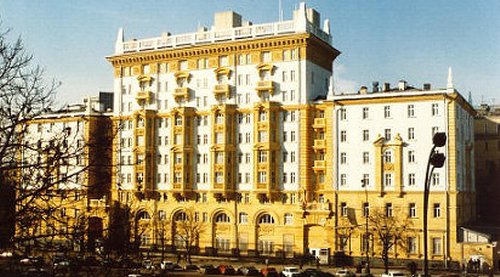
Foreign embassies have always been very
attractive intelligence targets. Embassy staff
and personnel often handle classified
information. One way to obtain such sensitive
information is by HUMINT (human intelligence)
from embassy personnel. Another - covert - method
is SIGINT (signals intelligence) by wiretapping
or advanced listening devices, commonly known as
bugs.
A most spectacular case of
electronic espionage occurred in the 1980s, at
the height of the Cold War, when it was
discovered that Soviet intelligence had
successfully implanted very sophisticated bugs in
a large number of electronic typewriters at the
U.S. embassy in Moscow.
From Tip to Operation
It all started in August 1983,
when a friendly government informed U.S.
intelligence that they found a curious bug,
implanted in equipment at their embassy. In
response, the U.S. National Security Agency (NSA)
sent communications security experts to their
ally to examine the bug. Its technology proved to
be very sophisticated. The efforts required to
develop such technology were of such a scale that
NSA was convinced that this was not a single
case.
NSA realized that such bugs
were most likely also implanted in U.S. embassy
equipment. This triggered a secret operation
codenamed GUNMAN. The first part of the operation
was to remove all equipment from the U.S. embassy
in Moscow and check it for bugs. This comprised
all crypto and communications equipment,
computers, printers and much more. However,
Soviet intelligence was to be kept ignorant of
the operation.
U.S. Embassy in Moscow 1983
The transport of the equipment
proved quite a logistic challenge. No less than
eleven tons of all kinds of equipment had to be
shipped from Russia back to NSA in the United
States and replaced by new equipment. All this
had to be done in complete secrecy. New
techniques and procedures had to be devised to
make sure that the new equipment, some ten tons,
wasn't again tampered with by the Soviets. At the
same time, they had to keep their own embassy
personnel ignorant of the real reasons for the
exchange of equipment. It took them five months.
Searching for Bugs
All recovered equipment was
stacked at Fort Meade. The next part of GUNMAN
was to carefully inspect and x-ray each single
item. All crypto gear soon proved clean. It took
them until July 1984, eleven months after the
tip-off, to discover the first bug in a
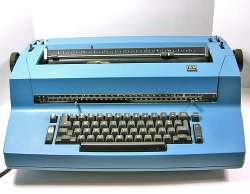
non-crypto device, an IBM Selectric typewriter.
It was an extra coil inside a power switch that
caught the attention of a technician. X-rays
revealed an electronic bug, hidden inside a metal
bar. Eventually, they found bugs in sixteen
Selectric type II and type III typewriters.
IBM Selectric II Typewrite
NSA technicians started
the complex task of reverse-engineering the bugs.
They turned out much more sophisticated than the
specialists could ever have imagined. Metal cams
were replaced by a non-ferromagnetic version that
contained strong little magnets. These magnets
caused magnetic disturbances when keys were
depressed on the keyboard. The magnetic changes
were picked up by the electronics, analyzed and
converted into a digital signal. The electronics
were hidden completely invisible and sealed into
a hollow support bar.
Ingenious High-Tech
The signal was compressed into
four-bit frequency selecting words. Up to eight
four-bit characters could be stored in a circuit
with tiny one-bit core memories. Only when the
memory was filled completely (at irregular
intervals due to the typist's tempo) the data was
sent in a very short burst transmission to a
nearby listening post. The burst frequency range
was selected deliberately in the same frequency
band as Soviet television stations to hide the
burst noise. The implants could be turned off
remotely to avoid detection when security
technicians would sweep the embassy for bugs.
The NSA technicians found
several different versions of the bug. Some
operated on batteries and others were powered by
the AC mains. Some bugs activated a beacon to
monitor whether a typewriter was turned on. The
technicians were stunned by the technology used
and the cleverness of the design to avoid
detection by technical teams.
NSA director General Faurer was
quoted in 1986: "I think people tend to fall
into the trap of being disdainful too often of
their adversaries. Recently, we tended to think
that in technical matters we were ahead of the
Soviet Union, for example in computers, aircraft
engines, cars. In recent years, we have
encountered surprise after surprise and are more
respectful."
That quote says it all. The
case had a major impact on all intelligence
agencies and many lessons were learned. A damage
assessment proved impossible because the
whereabouts of the typewriters during all those
years were never put on record. They do know that
from 1976 to 1984, Soviet intelligence used these
bugs to collect sensitive plaintext information,
typed on typewriters in the U.S. embassy in
Moscow and the U.S. consulate in Leningrad.
Lessons Learned and
Adapting
Now came the final part of the
GUNMAN project: awareness and prevention. New
procedures were implemented for secure shipping
of equipment, technologies were developed to make
equipment tamper proof and new guidelines were
written on how to handle classified information.
Over a period of seven years, special GUNMAN
briefings were given to various government
agencies and the intelligence community.
COMSEC (communications
security) was renamed into INFOSEC (information
security) to emphasize that security is not
merely a case of using secure communications
equipment but rather the secure handling of
critical information on whatever type of secure
or insecure equipment that might process
plaintext information. The lessons learned in
1984 are still applied in protecting information
that is handled inside embassies and other
critical buildings all over the world.
However, this story is also
relevant to all of us. Our computers have
numerous unknown processes running at the
background, multi-functional printer-scanners and
various mobile devices are constantly connected
to the Internet. We store and process all kinds
of confidential information on these new
technologies but hardly realize that they are
easily turned into bugs. This doesn't even
require the implant of sophisticated hardware
anymore, as in the GUNMAN case, but only a quick
reprogramming of internal software or hidden
spyware.
The old school spy equipment
has evolved into digital spyware. An evolution
quite dangerous when people constantly use these
modern media without thinking about the possible
consequences. Secrets can leak in most unexpected
ways, as the GUNMAN case has shown!
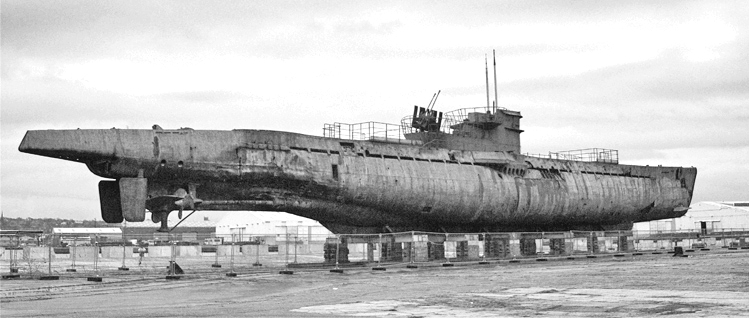
I just received fantastic news
from Michael Hörenberg, who
succeeded in deciphering 12 authentic
Kriegsmarine messages, encrypted with the famed
four-rotor Enigma M4 cipher machine. These are
recovered from the German WW2 U-boat U-534, one
of the very few U-boats that were either salvaged
or survived the war. U-534 was sunk in May 1945
by a British bomber. When she sank, she took with
her the secret documents and equipment used to
encrypt their communications. During the salvage
of the U-boat, some of the original message
sheets were recovered and preserved.
Meanwhile, Michael already
managed to recover the key settings to 12 of the
59 available messages with his M4 WinEnigma
(Turingbombe) and TBreaker software. Images of
the original recovered message sheets and their
plaintext version are available on his website.
This is fantastic news for the crypto community,
and Michael's achievement cannot be
underestimated.
Kriegsmarine Enigma M4 messages
are very rare, as they are much harder to decrypt
than those of the Enigma I, used by the Heer and
Luftwaffe. We are looking forward to the coming
results of his codebreaking project. Michael's
website contains detailed information about his
codebreaking project, the software used, and the
recovered U-534 messages. He also has a detailed
description of the Reservehandverfahren or RHV, a
manual backup system to encrypt messages.
Update
2: More
sensational news. The famous Karl Dönitz
message,
sent to all U-boats to announce Admiral Dönitz
as new Fuhrer after Adolf Hitler committed
suicide, is deciphered. You can also learn more
about degarbling the
Dönitz message.
The video below is part of the
U-534 exhibition in Birkenhead, UK, which also
shows one partially and one completely recovered
Enigma machine. Notice how well preserved all
artifacts are.
January 5, 1968. USS Pueblo
leaves the US Navy base in Yokosuka, Japan. Its
destiny is the Democratic People's Republic of
Korea (DPRK), commonly known as North Korea. USS
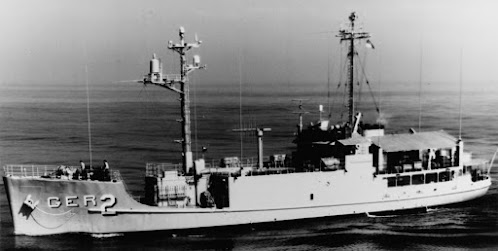
Pueblo, designated AGER-2 (Auxiliary General
Environmental Research), is a so-called technical
research ship for oceanographic survey.
USS Pueblo AGER-2 in 1967 (source: US Navy)
In reality, the vessel is
stuffed with SIGINT (Signals Intelligence) and
ELINT (Electronic Intelligence) equipment. Its
real mission is a joint Navy/NSA spy program to
eavesdrop on North Korean and Soviet
communications.
The Secret Mission
Detected
January 20. USS Pueblo is
observed a first time by a North Korean submarine
chaser at 16 miles from the North Korean coast.
Two days later, two fishing trawlers pass USS
Pueblo at very close distance of . The visitor is
sighted and events start to enroll. The next day,
January 23, USS Pueblo is approached by a DPRK
sub chaser and, according to the US Navy, is
challenged to show her nationality. After raising
the U.S. flag, USS Pueblo is ordered to stand
down or be fired upon.
According to the North Koreans,
USS Pueblo is well inside their territorial
waters. The U.S. version of the incident locates
the spy ship far outside North Korean territory,
but the North Koreans claim 50 nautical miles
territorial waters, where international standards
are 12 nautical miles. Whatever its position, USS
Pueblo is in serious trouble. She desperately
attempts to maneuver away from the much faster
DPRK sub chaser, which is joined shortly after by
four torpedo boats and another sub chaser. Two
MIG-21 fighter jets fly over.
Damage Contol and
Capture
For more than two hours, the
DPRK vessels attempt to board USS Pueblo and
repeatedly order the vessel to halt or be fired
upon. The spy ship constantly manoeuvres to avoid
the boarding but the cat and mouse game ends when
one sub chaser opens fire with its 57 mm cannon
on Pueblo's deck, wounding several crew members.
USS Pueblo also receives machine gun fire from
other DPRK vessels. Not equipped to respond to a
serious threat (only .50 caliber machine guns are
aboard but covered to avoid suspicion and thus
unmanned) USS Pueblo has no other option than to
comply.
During the incident, USS Pueblo
has continuous radio contact with the U.S. Naval
Security Group in Japan, but air support is not
available on time. Meanwhile, below deck,
intelligence personnel start destroying all
sensitive documents and equipment. Normally, such
spy ship, operating alone and close to enemy
waters without protection, should carry only the
absolute minimum of sensitive material. USS
Pueblo, however, is loaded with documents and
equipment. After an hour of emergency
destruction, only a small percentage of the
classified material aboard the ship is destroyed.
An intelligence disaster is inevitable.
USS Pueblo is forced to follow
the DPRK vessels but is fired upon again when she
stops just outside North Korean territorial
waters, killing one crew member and wounding
several others. North Korean personnel now boards
the vessel and takes over control. USS Pueblo is
taken to Wonsan Naval Base, in southeastern North
Korea. The Pueblo crew is moved to prisoner of
war camps where, according to the crew, they are
starved and regularly tortured while in North
Korean custody.
SIGINT Fallout and
Release of Crew
The capture of USS Pueblo was
an intelligence nightmare. North Korea and its
ally, the Soviets, seized large volumes of
sensitive documents and cryptographic equipment,
causing shock waves throughout the naval security
and intelligence community.
Eleven months later, and only
after a written apology and admission by the U.S.
that USS Pueblo had been spying, its crew was
released. On December 23, 1968, the 82 crew
members crossed the DMZ border with South Korea
(after the release, the U.S. immediately verbally
retracted the ransom admission). The story,
however, did not end with the release of the
prisoners.
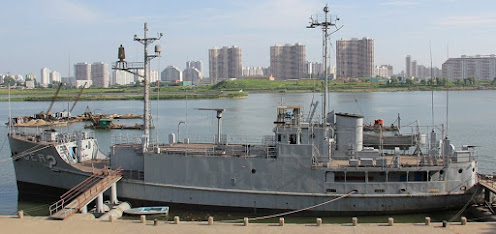
The captured USS Pueblo today in Pyongyang on the
Botong river (source: laika ac)
Since then, USS Pueblo remained
in the custody of North Korea. In 1999, the
vessel moved from Wonsan to the North Korean
capital Pyongyang, where it is now a primary
tourist attraction on the Botong river, alongside
the Victorious Fatherland Liberation War Museum.
USS Pueblo AGER-2 is the only American naval
vessel held in captivity in the world.
The National Security Archive's
The Secret Sentry
Declassified published two documents related to the
incident: The capture of the USS Pueblo and its
effect on SIGINT operations (pdf-document 3) and some
captured documents, from a North Korean expose on
the ship (pdf-document 24).
The TSEC/KW-7 teletype
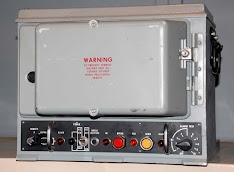
encryption and the KL-47, a Navy version of the TSEC/KL-7, were two of the crypto systems,
compromised in the incident. To this day, the
question remains whether the capture of USS
Pueblo was a coincidence, or triggered by
communications specialist John Walker's betrayal.
It is questionable whether
SIGINT and crypto equipment was indeed a planned
target. The North Koreans took long before
boarding the vessel, giving the crew the time to
destroy documents and equipment. More on the
ship's electronics at Jerry Proc's USS
Pueblo page.
Robert Derencin wrote a detailed overview of
Walker's spying in USS Pueblo, John
Walker and KGB (pdf).
A Risky Job
Such SIGINT and ELINT missions
have always been hazardous, even in peacetime.
The Cold War was all but cold for the many
intelligence technicians, sailors and pilots who
lost their lives while collecting intelligence.
Many SIGINT airplanes also got their share in the
losses.
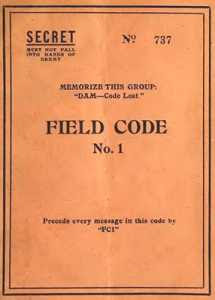
NICK GESSLER's CODEBOOK
COLLECTION05 November 2010
Gessler's Codebook
Collection
Nick Gessler published an
extensive collection of old military and civilian
codebooks. He scanned all pages of each book and
made them available as pdf files on his website.
The code books are dated
between 1878 and 1947. There are several military
field codes, Artillery codes, a 1941 Air-Ground
Liaison code, but also civilian codebooks:
Telegraph codes, railway codes, cotton trade
codes and various merchant and phrase codebooks,
Larabee cipher codes, an Imperial Combination
Code, Inter-State cipher and pocket codebooks.
These are all codebooks in the
true sense of the word code in cryptography:
large substitution tables to convert words and
phrases into letter groups or digits. Today, such
codebooks would not stand a change against
cryptanalysis. However, in the early days of
communications they did provide some security and
had another important benefit: they could reduce
the length of a message considerably. In the
1800's and early 1900's, the often-commercial
electric telegraph (land lines) were virtually
the only way to communicate over long-distance.
Reducing the message length was a plus if a
telegram was paid per word or per character.
LAMBROS CALLIMAHOS AND THE
DUNDEE JAR17 December 2010
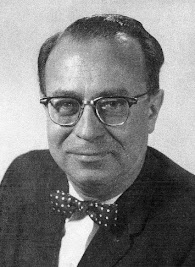
Lambros Callimahos
There's a curious story
at NSA about a marmalade jar that became a symbol
of cryptanalytic skills within the National
Security Agency. It all began in the late 1950's,
when Lambros Callimahos created the Intensive
Study Program in General Cryptanalysis (ISPGC),
also known as the CA-400 course.
It was the first extensive
high-level course for experienced and senior
cryptanalysts. Callimahos based his course on
William Friedman's manual on Military
Cryptanalysis. He revised and expanded Friedman's
work into the new training manuals Military
Cryptanalytics I and II and molded it into an
extremely demanding course, unequaled in wide
range of subjects and in dept.
The students rushed through the
Military Cryptanalytics manuals to continue with
exercises in cryptanalysis of codes, ciphers,
cipher machines and traffic analysis. While
solving their crypto problems, they were assisted
by aids who helped them to speed up their
paperwork. By doing so, Callimahos managed to
reduce a most complex course from 12 to 4 months.
Clearly not a course for wannabees who were still
wet in the pants!
He composed many new examples
and problems that the students had to solve. At
the end of each course, the students had to solve
the notorious Zendian Problem. The students
received 375 encrypted military messages,
intercepted from the fictional third-world
country Zendia. The messages were encrypted with
various manual systems and cipher machines.
Within two weeks, they had to break all
exploitable messages. It was the perfect
opportunity to merge all their skills into one
single fictional yet most difficult codebreaking
operation. The exercise prepared them perfectly
to tackle the real stuff.
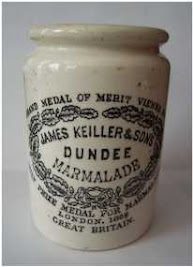
NSA's Dundee Jar
The course was also the
start of a tradition of gatherings for the
graduates at a local restaurant. While making the
reservation for diner, Callimahos faced the
problem that he could not disclose the real -
secret - purpose of the group.
He quickly devised the name
Dundee Society by looking at a marmalade jar that
served as a pencil holder at the CA-400 course.
The Dundee Society was born! Since then, every
graduate received a Dundee jar, which became a
symbol of a truly extraordinary course for elite
cryptanalysts. In 1977, Lambros Callimahos passed
away much too soon, at the age of 66.
If the Zendian Problem is
beyond your cryptanalytic skills, you can always
participate in the challenges on our website.
Those are quite accessible for those without
codebreaking experience.
FORMER STASI CRYPTOLOGISTS WORK
FOR NATO27 September 2010
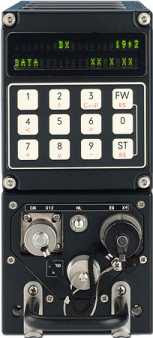
R&S Elcrodat 4-2
Voice & Data
Archives from the former
East German Ministerium für Staatssicherheit
(MfS), better known as the Stasi, have already
shown the excellent skills of their SIGINT
(Signals Intelligence) department HA III. Little
was known about what happened with all those most
capable experts after the fall of the Berlin Wall
and the collapse of the former German Democratic
Republic...until now.
The German magazine Der Spiegel
now revealed that cryptologists from the former
East German central cipher bureau ZCO (Zentralen
Chiffrierorgan), were secretly recruited by the
German Federal Office for Information Security
BSI (Bundesamt für Sicherheit in der
Informationstechnik). They are now employed at
Rohde & Schwarz SIT GmbH, a front company for
the secret recruiting operation and a subsidiary
of the renowned German communications and
security firm Rohde & Schwarz.
The Stasi cryptologists had
already proved very successful in both making and
breaking codes during the Cold War era. They
managed to break several encryption systems,
including the secure communications of the
West-German Foreign Intelligence Agency BND
(Bundesnachrichtendienst). The last thing the
German government wanted, after the dissolution
of East Germany in 1990, was the exodus of Stasi
crypto expertise to other countries. The
defection of these cryptologists and a compromise
of Western encryption technology to rogue states
would be a nightmare. It was decided to recruit
them, whatever it takes.
Rohde & Schwarz SIT became
both a surreptitious employment pool for former
Stasi crypto experts and a most successful
subsidiary of Rohde & Schwarz, in both
commercial and security terms. SIT took over
Siemens cryptology division and employs many of
Germany's top mathematicians. They are
specialized in Information and Communications
Security, offer encryption for numerous analog
and digital systems, and are currently an
important supplier of high security crypto
equipment for NATO.
Or how a former partner of the
Soviets, and enemy of NATO, eventually became a
vital part of NATO communications security. The
secret operation prevented that critical crypto
expertise fell into the worng hands, provided
experienced mathematicians for BSI's crypto
bureau. A win-win situation.
Let's just hope that none of
these Stasi cryptologists are still serving their
old mentor, the former KGB 8th Main Directorate
Communications and Cryptography, now absorbed by
Russia's SIGINT agency FAPSI). The German Federal
Intelligence BfV (Bundesamt für
Verfassungsschutz) undoubtedly has them all
checked thoroughly. Nevertheless, recruiting old
enemies is a hazardous undertaking, and
far-sighted Russian Intelligence has a splendid
record in long-term planning regarding former
Soviet states (see Hermann Simm).
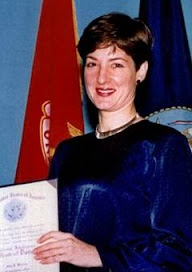
The August Spycast
edition is an interview with Scott Carmichael,
the Defense Intelligence Agency (DIA)
counterintelligence official who investigated the
Ana Belen Montes case. Montes, the senior Cuba
analyst at the DIA, was arrested in 2001 and
charged with committing espionage for Cuba.
The federal prosecutors stated
that Ana Montes communicated with the Cuban
Intelligence Service and received her
instructions through shortwave encrypted radio
transmissions from Cuba, the infamous
"Attencion" numbers
station (also in
Dutch/Nederlands).
As in the Spy With No Name
case
with Czech Cold War spy Vaclav Jelinek, a.k.a.
Erwin van Haarlem, the Montes case once again
confirms that those mysterious numbers stations
are indeed spy stations. The messages on these
radio stations are encrypted with the absolutely
secure one-time pad
(also in Dutch/Nederlands).
Crypto Museum also covers the Ana Belen Montes
case
and the radio equipment she used to receive Cuban
numbers station messages. More about Ana Montes
at the Latin American
Studies.
The article Cuban Agent Communications (pdf) explains the implementation flaws by
Cuben Intelligence and its agents Ana Montes,
Carlos Alvarez, and Walter Kendall Myers.
Spycast
interviewed Scott Carmichael from the
Defense Intelligence Agency, and investigative
journalist Jim Popkin on his
book Code Name Blue Wren: Cuban Spy Ana Montes,
the most damaging female spy in the United
States.
Update: Ana
Belen Montes, sentenced to 25 years in prison,
was released on January 6, 2023 after serving 20
years in prison. In 2002 she had pleaded guilty
and agreed to cooperate on a full debriefing of
her spying activities, to reduce her sentence and
avoid a possible death sentence.
Cryptology is a fascinating
science with an interesting history.
Unfortunately, few people know what cryptology
actually entails and what it means for us.
Codemakers and codebreakers have influenced
history since ancient times, shaping politics and
the outcomes of many wars in the past, and will
continue to do so in the future.
One of the reasons why
cryptology is relatively unknown to the general
public is that it has been a very obscure science
for centuries. Even now, few books on cryptology
reach the general public, and documentaries about
cryptology on science or history TV channels are
rare. Nevertheless, there are some very
interesting documentaries. Let's discover the
1990s U.S. National Security Agency.
If you want to
learn more about the fascinating world of
cryptography, historically or technically, then
visit our Book Reviews
(also in Dutch/Nederlands). The Codebreakers by David Kahn, The
Woman Who Smashed Codes, The Third Reich Is
Listening, and Station X are highly recommended.


 The
The 
.jpg)
 Spycast
interviewed
Spycast
interviewed