These
pages provide news, articles, and links about
historical ciphers and codes, cipher machines,
and cryptography-related exhibits and events,
from ancient history through the First and Second
World Wars to the Cold War and beyond.
If you
have interesting news on cryptologic
history, then contact
us. History
is here to share!
A CALL TO FORMER KL-7 AND KL-47
OPERATORS 08 July 2024 08 July 2024
TSEC/KL-7
The
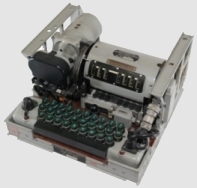
TSEC/KL-7 crypto machine was developed by the
Army Security Agency (ASA) and Armed Forces
Security Agency (AFSA) under the name AFSAM-7 and
introduced in 1953 by the National Security
Agency (NSA) into the U.S. Army and Air Force,
and later also into the CIA and FBI. The machine
also served in all NATO forces, their embassies
and some state departments. The U.S. Navy
AFSAM-47B, later known as the TSEC/KL-47, was
compatible with the KL-7. The last machines
retired in the early 1980s. It's been little over
40 years ago that the last machines left the
service and time is running out to document
first-hand accounts on these machines.
If you are a
retired signals veteran with experience on the
KL-7 or the KL-47, as operator or technician, a
member of a signals association or organization,
or worked in the communications section of a
state department that used the KL-7, then contact
us through our website to document your story.
The KL-7 is fully declassified, and we're not
interested in classified information, we only
want to preserve the cryptologic history of these
Cold War icons.
Besides the
United States, the KL-7 was also used by its NATO
allies Australia, Belgium, Canada, Denmark,
England, France, Germany, Greece, Italy,
Luxemburg, the Netherlands, Norway, New Zealand,
Portugal and Turkey. Outside NATO, the KL-7 was
also on loan to South Korea, South Vietnam and
Taiwan. If you're a signals veteran from any of
these countries, a state department or embassy in
the 1950s to 1980s era, then contact us, or
spread the word.
Unfortunately,
time is running out to document first-hand
accounts, as the people involved are age seventy
or older, and memories fade. Please share this
request with all signals communities that might
have former KL-7 or KL-47 operators and
technicians. Those who share their story retain
full control over the content and how it is
published.
Help us
preserve cryptologic history!
Visit the US TSEC/KL-7 ADONIS & POLLUX in
English or Nederlands to
learn more about the KL-7, its development,
technical details and full history, including
some first-hand accounts. To get an idea of the
kind of stories we hope to document, read the
below documents. You can contact us through the
contact page in English or Nederlands.
The
history of crypto equipment is quite fascinating,
but diving into the archives, searching for
historical publications, or collecting those old
machines is not everyone’s cup of tea.
Luckily, we have a community, dedicated to
preserving the history of old crypto equipment,
research the technical details, publish their
history and operational use, and bring those old
crypto machines back to life, either physically,
which can be quite expensive, or virtually
through software simulations
Writing software that works
exactly like the real crypto machine requires
extensive study of the original machine, its
mechanical and/or electrical properties, and many
hours to write the software that reproduces the
plaintext or ciphertext exactly like the original
machine. However, you could take it one step
further and make a virtual three-dimensional
machine where you can manipulate all components
and encrypt, decrypt or break messages, just like
the wartime operators.
Martin Gillow created a
website with no less than ten 3D simulations. The
virtual British Colossus machine is the first
ever digital computer, developed in WW2 to break
the German Lorenz SZ40/42 encrypted telex, of
which he also created a virtual version.
There’s also the virtual Enigma machine, and
the Bombe that was used by the Bletchley Park
codebreakers to decrypt the German Enigma
messages.
The British Typex machine and
the U.S. M-209, developed by the renowned Swedish
engineer Boris Hagelin, also have their 3D
version. Moreover, the collection includes the
ICT 1301 ”Flossie” second-generation
computer, the E.R.N.I.E. electronic random number
generator, and the American crib dragging machine
Dragon that helped to break the Lorenz messages.
Of course, the countless hours
of work by Martin to research and study those
machines, and write accurate 3D versions, is just
enormous, and makes this 3D collection simply
unaffordable… unless you just want to
preserve and share the history of old crypto
machines, and make the simulations available to
everyone for free. A big Thank You to Martin for creating all those
virtual machines, and for being part of that
small community, dedicated to preserve
cryptologic history.
Make sure to scroll all the way
down his main page, to find all virtual 3D
simulations and read the various tutorials on how
to use them. Also click the relevant "find
out more" buttons to learn about each
machine and its history. Visit the Virtual
Colossus website.
Highly recommended, and no
better day than D-day to share Martin's work and
commemorate all codebreakers.
CIPHER
MACHINES 3D-CT DIGITALISATION29
January 2024
The Deutsches Museum in
Munich made available a large collection of
Cipher Machines 3D CT scans. The 3D-CT
digitization project for historical cipher
machines uses computed tomography, based on X-ray
technology. This enabled the researchers to
examine objects in detail, without disassembling
their components and risking damage.
Visit the CT-Viewer to explore
the collection of 63 different cipher machines in
high resolution. Select one of the cipher
machines and click the Slice View button to
explore any slice of the machines. Choose a YX
orientation and move the slice control to travel
through the machine. Scroll the mouse to zoom in.
Select the Volume View button
to explore the scans in full 3D. Hold the mouse
button and move the mouse to turn the cipher
machines in any direction. With the mouse wheel
you zoom in and see the machines in great detail.
Once you have the desired view, you can select
the High Resolution option to see the tiniest
details.
The slice view is particularly
interesting to examine the inside of components
that are too fragile to disassemble. In the above
scan you can explore the rotors with the scan
slices coming towards you. Choose the Enigma M4 (opens in
new window), select menu Slice View, orientation
YZ and high resolution. Scroll the mouse to zoom
in.
Use the slice text field (more
accurate than the slider). Enter 345 to adjust
the slice and see a rotor notch ring that carries
the letters (press the enter key to validate).
Enter 360 to see the internal wiring of the rotor
core, 380 for the locking arcs to adjust notch
ring setting, 395 for the thumb wheel and 405 for
the rotor ratchet and the stepping pawl that
moves the rotor. You can zoom in by scrolling the
mouse. You just disassembled an Enigma rotor
without touching!
Visit the Deutsches Museum
3D-Cipher page to explore all machines and learn all
about the 3D scanner, the technology and how they
visualize the machines and animations. You can
also visit their excellent cipher machines
collection.
COMPUTERS
AND CRYPTOGRAPHY23 February 2023
The development
of computers is closely intertwined with the
history of cryptography, and vice versa. The
mechanization of cryptography during the early
20th century slowly began to exceed the skills of
cryptanalysts to break such encryption. The only
way to break these ciphers was to mechanize the
breaking of ciphers. Colossus, the first
programmable digital computer, was developed
exactly for that purpose during World War II.
Until the early 1950s,
computers were only used by government agencies
for codebreaking, the military, weapons
development and research. In 1951, the UNIVAC was
the first commercially produced digital computer,
but computers were mainly used by universities
and large corporations like IBM and General
Electric. Programming those large mainframe
computers was a complex task.
Making Computers
Accessible
This changed when Professors
John Kemeny and Tom Kurtz from Dartmouth research
university got the, I quote, crazy idea to
develop a simple language to make programming
easier and more accessible for non-technical
undergraduate students.
However, they first had to buy
a computer. Since there was no budget for
computers, they bought a Librascope LGP-30
computer, an optical tape reader and a typewriter
console for a total of $37,040 and booked it
under furniture. That's $383,434 in present 2023.
John Kemeny wrote the compiler
to translate the new language into machine
language for the LGP-30. This new language was
named BASIC (Beginners' All-purpose Symbolic
Instruction Code) and made programming easier
than ever.
Moreover, to make BASIC
accessible to as many students as possible, they
implemented time sharing (sharing computing
resource) on the LGP-30 computer to enable
several students to independently work on their
own console typewriter, remotely and
simultaneously, processed on one single computer.
This idea resulted in students lining up to learn
programming with BASIC, the computer language
that remains popular to this day.
Crypto Going Mainstream
For many people, BASIC was
their first programming language when small
computers became commercially available in the
late 1970s. This was the era where people who
bought a computer usually also learned to
program. They were often called nerds,
because… who on earth needs a computer?
Yeah, sure.
The rapidly growing number of
computers and users spurred the development of
crypto algorithms by others than then government
and the few commercial firms that build crypto
equipment. This fueled the everlasting
competition between codemakers and codebreakers,
and between state and citizens. This evolution
also democratized cryptography and digital
privacy. It all started when two professors
decided to make programming easier. More on
development of BASIC in the video below.
On our website you find a brief
history of cryptography, and learn more about the Colossus
computer, used by the
British codebreaker during the Second World War
to break the German Lorenz SZ40/42 machine, used
for their high-level communications.
RN Communications Branch
Museum/Library 06 November 2022
HMS Mercury
Royal Navy Signals School
Sometimes you need a bit of
serendipity to discover a fascinating website. I
researched the TSEC/KL-7 cipher machine for long
and was able to find many declassified documents
on this 1950s cryptologic gem that served until
the early 1980s. Initially named AFSAM-7, the
KL-7 was developed for all US armed forces, but
the US Navy developed its own fully compatible
version with a few more options, named AFSAM-47B,
later designated KL-47.
Unfortunately, little was known
about the use of the KL-7 by the British Army,
Navy and Air Force. However, several NATO
documents linked Royal Navy patrol boats,
minesweepers and submarines to the KL-7 instead
of the naval KL-47. The search engine keywords
KL-7 and Navy, and a bit of serendipity, led me
to the RN Communications Branch Museum/Library.
This website is a private
initiative from Ken Sutton, who served from 1966
until 1998 in the Royal Navy (RN) and retired as
Warrant Officer 1st Class. He then served as
civilian Communications Training Design Officer
until 2012.
RN Comms Museum History
The museum/library has existed
since the late 1800s when the RN Signal School
was based in the RN Barracks Portsmouth, now HMS
Nelson base. In 1941 the Signal School and its
library moved to the HMS Mercury shore
establishment near Petersfield, where the library
was maintained and a small museum was
established.
HMS Mercury closed in 1993 and
moved into HMS Collingwood shore establishment in
Fareham. Unfortunately, no space was allocated
for the Mercury museum and library, leaving all
exhibits kept in cupboards and drawers. The Royal
Navy Signals history comprises several branches
and specific expertises, of which the
communicators were the workforce, and still are
today.
The badges of Tactical,
Women's Royal Naval Service and
Telegraphist/Sparkers
The first badge (crossed flags)
is the Tactical badge, the branch that dealt with
all comms by flashing light, semaphore, flag
hoists, with expertise in the maneuvering of
ships. This side of the branch was transferred to
the Seaman Specialist branch circa 2004.
The second badge (blue gold
wings) is the Telegraphist/Sparkers badge of
Women's Royal Naval Service (WRNS) Communicators
from the era that WRNS served mainly in shore
communications centers worldwide. Few were morse
trained and most trained in message handling.
They also were trained to encipher and decipher
messages using various systems. Notably, they
also made up the majority of GC&CS personnel
in Bletchely Park during WWII. They eventually
integrated in the RN and now serve aboard navy
vessels, informally still known by the nickname
"wrens".
The third badge (gold wings) is
the Telegraphist/Sparkers badge of the branch
that dealt with all radio communications. Today,
this branch is referred to as the Communication
and Information Systems branch (CIS) due to the
amount of computerised systems used in the
communications world.
Preserving History
When Ken Sutton retired in
2012, he volunteered to set it all up again. The
museum is not an official RN museum, even though
it resides in a naval establishment. He created
the website to make the museum's exhibits and
documents available to all RN Communicators past
and present without having to travel long
distances to visit it.
His small website turned into a
major project when Jeff Dykes, a former Warrant
Officer Radio Supervisor, requested Ken to
incorporate his huge archive about all things
Navy into the RN Comms Museum website. That's
where I found the first accounts from Royal Navy
personnel on the KL-7.
The website has a huge
collection of technical information about naval
communications, transmitters and receivers,
technical drawings and photos, but also about how
the Royal Navy is organized, from information on
submarine warfare to burial at sea. You name it,
and there's a page about it. Now, back to the
KL-7.
The RN Comms Cryptography page describes
in detail the KL-7 and its early use in the Royal
Navy. More about the KL-7, and how it was used,
at the Cold War
Cryptography page. Do visit Ken Sutton's RN Communications
Branch Museum/Library and make
sure to check out the Sparkers and Snippets
menus, each of which has several sub-menus with
many more pages, hundreds! Use their Search Page
to find specific items in the vast collection.
JOSEPH HELMICH AND THE KL-7 FOR
CASH SPY CASE 02 August 2022
Joseph Helmich
The well-known John
Walker spy case from 1985 was covered extensively
by the press. In 1968 he sold the technical
details of the TSEC/KL-47 crypto machine (Navy
version of the KL-7) to the Soviets and provided
them more than 17 years the secret key sheets,
causing tremendous damage to U.S. Naval
communications. However, he was not the first to
do so.
Joseph Helmich already
compromised the KL-7 five years earlier, but his
case is hardly known to the public. Both Walker
and Helmich were only caught after 17 years, but
textbook spy candidate Helmich could have been
caught much sooner.
Career in Signals
Joseph Helmich (°1937 +2002)
entered the U.S. Army in 1954. After Signal
School training he served two years in Korea. In
1958 he received a Top Secret clearance at the
Signal Training Center in Fort Gordon. Later that
year he served at the U.S. Communications Zone
Europe in Orleans, France and from 1959 until
1963 in the 275th Signal Company in Paris.
Meanwhile, he was appointed Warrant Officer, now
had a Top Secret clearance, and worked as
custodian for classified cryptologic documents.
While in Paris, Helmich got
into financial trouble and wrote some bad checks.
To avoid court-martial and solve his debts he
contacted the Soviet embassy and offered to sell
classified information. He met with a Soviet
agent, working undercover at the Soviet Trade
Mission in Paris and received instructions in
espionage tradecraft. He provided the Soviets
with the repair manuals of the KL-7, the secret
internal wiring of its rotor and the secret daily
key lists.
Keys for Cash
Helmich moved in 1964 to Fort
Bragg and served in a signal battalion. He made
several trips to Paris to meet his handler, a GRU
Soviet Military Intelligence officer. Each time,
he provided copies of key lists from the KL-7, at
that time the most used crypto machine by U.S.
troops in Vietnam and by many of their allies. He
was paid at least $131,000 but he was going to be
sent to Vietnam soon.
Meanwhile, Helmich owned his
own home and two jaguar cars, quite unusual for a
28-year-old of his rank. This triggered an
investigation and he explained that his wealth
came from an investment in France and gambling.
Both claims proved unverifiable and he refused a
polygraph examination. As a result, his Vietnam
assignment with the Army Security Agency (ASA), a
unit responsible for communications security, was
turned down. Instead, he was sent to a supply
unit in Vietnam.
After returning from Vietnam,
his security clearance was revoked due to serious
financial problems. He decided to quit the Army,
rather than being discharged, and got work as a
car salesman. It seemed as they would never
discover his betrayal…
Connecting the Dots
In 1974 the FBI received
information from a well-placed source that
someone with the codename “Greenwood”
worked for the GRU. The unidentified person had
served in France, had experience in radio
interception, served from late 1964 a year in
Vietnam and then quit the Army, although still
ten years to go. This was the start of FBI
counterintelligence operation
"Hookshot" to identify the spy. They
informed U.S Army Intelligence and Security
Command INSCOM to investigate who could fit that
profile.
INSCOM reported that Joseph
Helmich perfectly fit that profile and the FBI
started an extensive investigation with
surveillance, all in utmost secrecy to avoid
alarming Helmich. His telephone records, jobs,
earnings, and bank accounts were checked and they
discovered several inconsistencies. He had earned
$3,000 in three months ($18,000 in present 2022),
way more than his wage as a car salesman. He was
kept under surveillance for six years.
In 1980 it seemed that
Helmich’s life went from poor to rich and
back to poor. He now lived near Fort Gordon with
its SIGINT training facility and the Charleston
Navy nuclear submarine base, two sensitive
locations. The FBI suspected that he might still
have contact with Soviet intelligence.
New Contact and Arrest
From early on, the Soviets had
deposited each of his payments in Switzerland.
End of May 1980 Helmich traveled to Canada and
visited the Soviet embassy in Ottawa to inquire
about getting some of that money. He was told to
go to Paris. The FBI, however, was on his tail
and aware of the Soviet embassy visit. Helmich,
at the time unemployed, returned to the United
States but did not return to his home, had sold
all his furniture and his home was for sale.
It was now time for the FBI to
bring in Helmich and debrief him, including
polygraph tests. He was interrogated extensively
in the following year and was also caught trying
to deceive the FBI. Helmich was arrested in July
1981 and indicted on four counts of espionage.
Two months later he eventually
pleaded guilty to conspiracy to commit espionage
by giving the Russians a maintenance manual,
technical details and key lists for the KL-7
crypto system. The government dropped three other
counts under a plea agreement. He was sentenced
to life imprisonment. In 2002, Joseph Helmich
died in prison at the age of 65.
Clear Signs and
Warnings
This was a textbook spy case
that could have been avoided. People with
security clearance who can't handle money are
always a risk because money is an important
incentive to espionage. If such a person
nevertheless gets affluent, has no provable
explanation, and refuses a polygraph, then all
bells should ring. You can either help to solve
their problems or prevent access to classified
information.
It was only due to a
combination of circumstances that Helmich was
thoroughly investigated. The source who tipped
off the FBI, the criteria only fitted Helmich,
records showed both wealth and debts, and his
refusal of a polygraph. FBI counterintelligence
then put its teeth in the case and had the
patience to wait until he made a mistake. He did
and was caught. In the end, he paid dearly for
having trivial financial problems and then
solving them the wrong way.
Some newspapers reported that
the FBI "stumbled" on Helmich when a
Soviet KGB agent they were trailing met with
Helmich to discuss a payment, "according to
an American intelligence source". This was
obviously a cover story to protect the
well-placed source inside Soviet intelligence.
Disclosing that information could have enabled
Soviet counterintelligence to identify the mole.
TSEC/KL-7
ADONIS & POLLUX Detailed page with all
technical details and the full history of
the KL-7, its use by the U.S military,
CIA, FBI, NATO and other allies,
including many declassified documents.
Also available in Dutch/Nederlands.
THE
ICONIC CRYPTO AG DISAPPEARS17
June 2021
Secret Backdoors...
The recent removal of the
iconic Crypto AG logo from its building is the
final milestone in the history of the once
renowned firm that sold state-of-the-art crypto
equipment all over the world. The iconic 1960s
building, located in Steinhausen, Switzerland, is
to be demolished to make room for apartments.
This tale however has a stinging aftermath.
This milestone also ends the
rather naive era of relying on foreign commercial
firms for critical secure communications,
certainly in today's digital world. The fate of
Crypto AG was sealed in early 2020 when documents
revealed the firm was secretly owned by the CIA
and West-German federal intelligence service BND
since 1970, making it the largest ever compromise
of secure communications. Apart from the
consequences for the customers and the firm's
reputation, this was also a tragedy for the
Crypto AG employees.
Take a look at the splendid
photos from the abandonned
Crypto AG building, taken by photographer Patrick Hürlimann. Seeing
these pictures of the empty building, offices and
storage rooms, you cannot but feel sad for the
many employees, once buzzing around in the
hallways and factory, who genuinely gave their
best and took pride in developing quality
equipment for the best crypto firm in the world.
Crypto AG also took good care
of its well-paid employees, including many
benefits. The sailboat in one of the pictures is
an eerie reminder of the good times, when
employees were allowed to sail the firm's boat on
Zugersee, the nearby lake. Eventually, some of
the firm's engineers and mathematicians became
suspicious about interventions by external
advisors or illogical modifications to their
equipment, but they were either stonewalled by
the staff or suddenly lost their job.
To leave behind a lifetime of
working can be tough, certainly when they always
worked with pride, but imagine seeing decades of
hard work turn into an illusion of lies and
spying. Not the career ending they dreamed of.
But they were not the only disillusioned ones.
Unaware that Crypto AG was
owned by the BND and CIA, Swedish entrepreneur
Andreas Linde took over the firm and its name in
2018 and established Crypto International AG. In the
wake of the revelations, with the export license
suspended, Linde had no other option than to
dismiss virtually all employees in mid-2020.
Earlier this year, a special
prosecutor was appointed to investigate the spy
scandal. In May, the Swiss intelligence chief
announced he will step down end of August,
following criticism about his handling of the
Crypto AG case after the scandal broke out. Below
the Swiss Radio & TV SRF documentary on
Crypto AG (translated subtitles available)
Crypto AG
& Operation RUBICON is the full story about
Operation RUBICON, the CIA and BND
joint-purchase of Crypto AG at the Crypto
Museum website.
MURPHY'S
LAW AT THE NATIONAL SECURITY AGENCY09
July 2020
No Such Agency
Five years ago, the National
Security Agency (NSA) once again released David
Boak's History of U.S. Communications Security,
this time almost completely unredacted. A most
interesting document with lectures about various
crypto topics, but at the very end there's a
chapter titled "Murphy’s Law", and
it's a fun read.
Communications security
encompasses extensive technical requirements and
procedures that must be followed. It’s a
huge challenge for NSA to draw up regulations
that cover all possible safety risks. They do
their best, but no matter how hard you try,
there’s always Murphy's law.
Some security violations, no
jokes but actual incidents, ended up in the
COMSEC lectures. They even kept records of
security violations, publicized them and ran
contests to see what organization could go
longest without violation. I won't reveal how
they end, and you'll have to read it yourself,
and there are more stories to discover...
They once suspected the
unauthorized use of crypto materials, and a TOP
SECRET key list was examined for fingerprints in
their chemical lab. They placed the key list on a
bench underneath a powerful ventilation system
and, you guessed, the key list got sucked up and
disappeared. They quickly dispatched some people
to the roof to inspect the exit of the duct, but
no secret key list. Flown away or stuck somewhere
in the hundreds of feet of ducting?
NSA, we have a problem! A small
step for man, one giant violation for COMSEC.
NSA had a warehouse in Fort
Holabird where they stored a lot of crypto
material. The warehouse was fenced and protected
by armed guards. One evening, a man was detected
inside the fence. The guard shouted
“Halt!” but the man climbed over the
fence and escaped. The guard could not shoot him.
The reason? You won’t believe.
There’s also the story of
one-time tapes, produced by NSA. These punched
tapes inevitably produced huge amounts of waste
product, tiny round pieces of paper. These chads
were collected in burn bags. Some genius had the
brilliant idea to give that confetti to high
school kids for use at football games. That
resulted in a school girls’ father emergency
destroying and flushing TOP SECRET keys.
A technical team once had to do
a sweep of a Naval Security Station to trace
suspected wiring. The inspector opened a floor
access plate to examine telephone wiring. He saw
a wire that was moving, so he quickly grabbed the
wire and pulled it out a few feet, but then the
wire began to fight back. What the hell was going
on? Want to know how the incidents ended?
If you're in for more fun with
crypto, do visit Jerry Proc's
Crypto Humour page. with real stories from the fringes of
communications security. Jerry hosts the
excellent Crypto Machines
website
with extensive information about numerous crypto
devices.
OPERATION
VULA'S SECURE COMMUNICATIONS14
November 2016
Operation Vula was the creation
of an underground ANC leadership with supporting
secure communications network in South Africa to
fight against the apartheid regime. The operation
ran from 1988 to 1991 and is also the fascinating
story of Tim Jenkin, who played a key role in
providing secure communications.
Going Underground
Tim Jenkin today
Tim Jenkin came into contact
with the anti-apartheid movement when he visited
the African National Congress (ANC) office in
London. He was eager to support the fight against
apartheid. Jenkin was trained in covert
operations and returned to South Africa where he
and his good friend Stephen Lee started
underground work for ANC in 1975.
They ran a propaganda shop but
got arrested in 1978 and were sentenced to
respectively 12 and 8 years imprisonment.
Amazingly, they escaped 18 months later from a
Pretoria high security prison with keys that
Jenkin made out of wood. This gives you an idea
of how creative he was. Jenkin left South Africa
and made his way to the ANC office in London
where he became a trainer for underground
operatives.
ANC Going Blind in
Exile
The ANC leadership had fled to
Lusaka in Zambia after many of their leaders and
members were jailed or tortured. This left the
ANC with no representatives in South Africa.
Among the exiled members were ANC president
Oliver Tambo, commander of the military wing (MK)
Siphiwe Nyanda and ANC strategist Mac Maharaj,
whose mission was to revive the freedom movement
and ignite revolution in South Africa.
This proved to be a mission
impossible because of the problems to communicate
and coordinate with the few ANC members that were
still in South Africa. In the mid 1980s,
communications between London, Lusaka and
operatives in South Africa were still protected
by manual one-time pad encryption that was too
cumbersome for long reports that took many hours
up to days to encrypt by hand.
Oliver Tambo tasked Siphiwe
Nyanda to join MK's Chief of Staff Joe Slovo in
starting up Operation Vula. The goal of this
extensive operation was to set up a secure covert
communications network and to smuggle ANC leaders
and weapons into South Africa to install a
leadership that would take over command of the
underground work. This is where Tim Jenkin comes
into play.
Jenkin met Mac Haharaj while
training ANC agents on radio communications in
Lusaka. Haharaj asked him to set up secure
communications between covert operatives in South
Africa and the ANC office in London. At that
time, Jenkin was experimenting with computer
communications.
Establishing Secure
Communications
Personal computers were quite a
novelty in the 1980s but handyman Jenkin
developed one-time pad encryption software that
used floppy disks, filled with random data, to
serve as key. During encryption, used key bytes
were automatically wiped from the disk, making
the system unbreakable. The software also
increased encryption speed for Vula messages
considerably, compared to the slow pen-and-paper
system.
Jenkin's office in London,
nicknamed GCHQ (after the British Signals
Intelligence organization) served as the main
Vula communications hub for messages between
London, Lusaka and South Africa. In his computer
shack he developed, tested and ran secure
communications to cope with the increasing number
of reports from and to the ANC underground
leadership.
Tim Jenkin in his communications
hub
Jenkin devised a system to
convert encrypted message digits into DTMF
(dual-tone multi-frequency) telephone dial tones
that were then recorded onto cassette tapes for
transmission by pay phone later one. They
provided ANC operatives with several DTMF tone
generators that were disguised as electronic
calculators. Later on, they dropped the method of
manually keying in the DTMF tones and drastically
increased communication speed by recording the
computer modem sound directly to tape.
Setting Up the Network
Conny Braam, a Dutch
anti-apartheid activist, became responsible for
the Vula logistics. She ran a network of people
that supported the entire operation. First task
was to get the network running. She had to find
someone to travel several times a month between
Amsterdam and Johannesburg. Air hostess
Antoinette Vogelsang volunteered as courier.
Being an air hostess, she didn't have to go
through airport checks and could safely smuggle
into South Africa the Toshiba laptops and
software that secured the network. She also
provided the communication hubs with a regular
supply of floppy disks, containing new one-time
pad keys.
The Dutch Lucia Raadschelders
was sent to Lusaka to run a communications hub
from a small house in the slums. She also served
as contact between Jenkin and ANC headquarters in
Lusaka. Janet Love, the ANC underground operative
in Johannesburg switched from the slow manual
one-time pad encryption to its fast computerized
version. Everything was finally up and running.
In 1988, Mac Maharaj and Siphiwe Nyanda were the
first Vula leaders to clandestinely infiltrated
into South Africa.
Meanwhile, Janet Love's
communications hub in Johannesburg was also
operational. Tim Jenkin received the first long
reports from Mac Maharaj a few weeks later. ANC's
freedom movement finally was able to communicate
securely with Jenkin's London office as central
hub. From then on, Janet Love encrypted all
Johannesburg messages and recorded the computer
modem sound on cassette tape.
From South Africa over
London to Mandela
The operative in South Africa
chose a random pay phone to call an answering
machine in London and played back the tape with
the message that he had encrypted and recorded
earlier. The London office checked the message
and called the operative's pager with a specific
code to signal that the message had arrived well.
London then relayed this message to, for
instance, ANC headquarters in Lusaka.
The London office also used a
specific pager code to warn operatives in South
Africa that there were messages for them to
receive. To retrieve a message, the operative
again chose a random pay phone and called another
answering machine in London on which the London
HQ had recorded an encrypted message from Lusaka
or from other operatives.
From the manual encryption of
long reports, taking many hours to encrypt and
days to get across, they now were able to get a
message to London in one or two hours. Jenkin
relayed the messages almost real-time back and
forth between the ANC headquarter in Lusaka and
the operatives in South Africa. The South African
security services could not track these messages
as they were sent anonymously from randomly
chosen pay phones. It would require them to
monitor each and every pay phone and even if they
managed to intercept such a message, it would
merely contain what seemed like unintelligible
fax or computer tones, giving them no clue about
their purpose.
Mac Maharaj succeeded in
setting up covert communications with the
imprisoned Nelson Mandela through his lawyers. By
then, the South African government held secret
talks with Mandela, who they believed to be
clueless about the situation in the country.
Little did they know that Mandela was in direct
contact with ANC president Oliver Tambo and a
well organized underground leadership. In fact,
without realizing it, the apartheid regime was
negotiating directly with the ANC. When Nelson
Mandela was released from prison in February
1990, the Vula operation continued underground to
protect the actual leadership and its
communications with Mandela.
Caught But Mission
Accomplished
The operation was eventually
compromised in July 1990 after the police
followed Siphiwe Nyanda and discovered encryption
disks and plain messages in a Vula hide-out. Mac
Maharaj, Siphiwe Nyanda and six other Vula
members were arrested and imprisoned. Others fled
the country or went into hiding. Despite this
setback, Tim Jenkin was able to reboot the Vula
network within 24 hours. All Vula members
eventually received amnesty as part of the
political transition that led to the end of
apartheid.
Tim Jenkin's story is an
amazing example of people with no background in
intelligence, espionage tradecraft or secure
communications who used their creativity to set
up an ingenious international secure network that
changed South Africa's history. It should be
noted that their communications system, which was
quite novel and therefore secure in the 1980s,
would pose serious risks in today's world with
advanced signals intelligence capabilities,
ranging from hacking computers to extensive
electronic surveillance and geolocation.
TATJANA
J. VAN VARK AT SECRET COMMUNICATIONS 2 13 November
2016
The Crypto Museum and the Foundation for
German Communication and Related Technologies again
teamed up to present their second Secret
Communications exhibit. This unique and meanwhile
international event brings together the finest
pieces of historical crypto and covert radio
equipment, some of which has never been on public
display before (non-exhaustive list here). I
visited the opening day, but the collection can
be visited two three (!) more days in the coming
weeks. Due to its immense success, there will be
an additional exhibit on January 14.
This year, we have the honor of
receiving Tatjana Joëlle van Vark, a Dutch lady
who is impossible to introduce in a few words. On
November 12 she gave a demonstration of her
amazing, hand-crafted Cryptograph machine and we
were fortunate to talk with her. She will give a
second demonstration on December 3.
Although inspired by the German
Enigma Machine, the Cryptograph is quite
different and more complex in mechanical design.
Her machine includes encryption of letters,
digits and punctuations, a printer and paper tape
puncher and reader.
Tatjana explains the mechanics of the Cryptograph
Some call it a Super Enigma,
but I prefer to see it more as a piece of
artwork. Tatjana is a lady who strives for
perfection and beauty. The sophistication and
attention to detail are a crucial part of all her
projects and the hallmark of her work and
philosophy. From the tiniest metal parts, over
tidy packed wiring to the shiny instrument
panels, it all breathes perfection.
The Cryptograph. An artwork of electro-mechanical
design and beauty
Personally, I believe that
somewhere along the road we lost the desire to
create beauty in everyday items. Everyone knows
those old radios, from little design pieces to
beautiful wood crafted receivers, but also the
gracious curves of kitchen machines and other
household items, all produced with excellent and
durable materials. This craftsmanship and design
has almost become a lost art. Sadly, today's
products in simple plastic boxes are often a hymn
to cheap mass production.
Not so with Tatjana J. van
Vark! Her projects arise from her imagination and
are shaped and developed solely in her mind. She
doesn't use technical drawings or plans and works
straight from her memory! She has what we can
call a beautiful mind, supplemented with skilled
hands that put raw materials into all kinds of
precision parts, assembled into devices that are
no longer simply functional objects but true
pieces of art. The true art of creating things.
Talking about Enigma, Tatjana
is above all an enigmatic person. Her interest in
scientific instruments as a child evolved into
scientific work for technology firms, government
and military. Her work includes such a wide range
of science and technology that can only be
explained by her drive to understand and learn
all and everything. Power systems, electronics,
telephone switching, instruments for the pharmacy
industry, aircraft avionics, radar and weapons
control, navigational equipment, optics. You name
it, she did it.
She explained to me that you
can create anything, as long as you learn enough
and think enough about it. Now that's the spirit
of a true explorer. I can only end with admitting
being really jealous of that lady's talents.
Much more to discover at Secret Communications 2
You will have another chance to
meet Tatjana J. van Vark and her Cryptograph on
the last day of the Secret Communications
exhibition on December 3. More info about the
unique Secret Communications 2 exhibition, its
amazing list of displayed items and directions to
its location near Amsterdam in the Netherlands at
this link. Be advised that roadworks are in
progress near the exhibition and alternative
directions are available.
If you can't make it to the
exhibition, then you should visit Tatjana J. van
Vark's website and her amazing collection of home
brew instruments with many amazing photos (make sure to
click each image for more details) or visit her
page at the Craftsmanshipmuseum. Below a
short documentary (subtitles included) showing
some of Tatjana Joëlle van Vark's extraordinary
work.